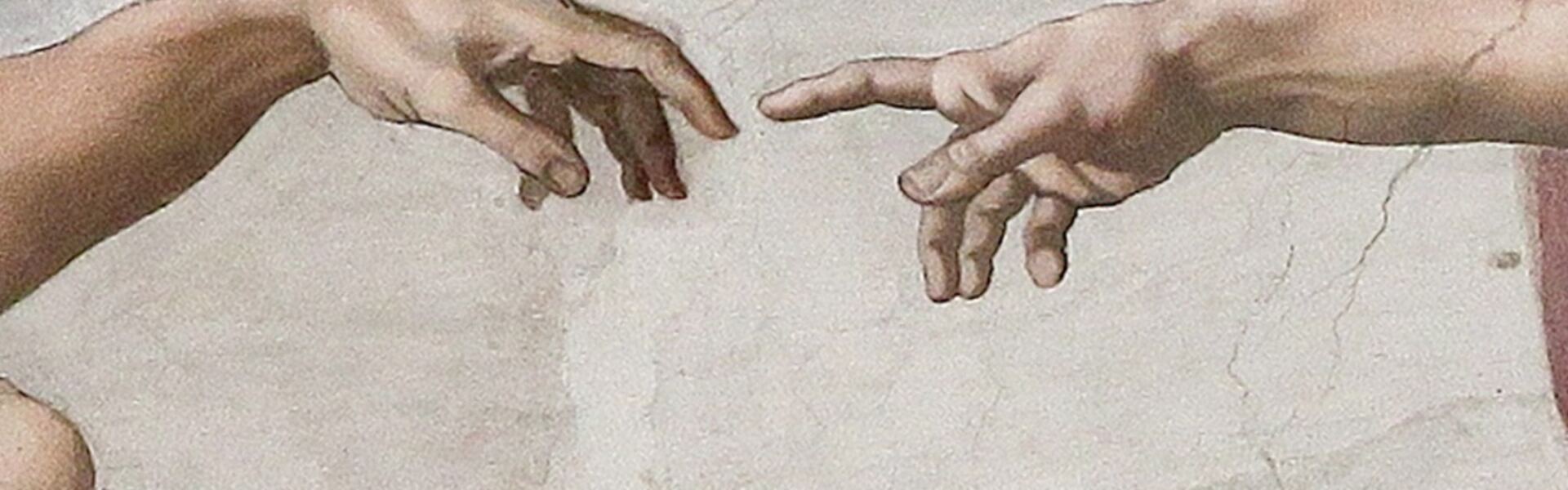
Energy healing with hands is probably the oldest form of care we know. A mother does it when her child bumps a knee; many traditions do it through the laying on of hands; today it lives on in practices such as Therapeutic Touch, Reiki and external qigong. In this article we look at what the research really says, where its limits are, and why this modality is, by its nature, dual. Then we explain why that does not take away its value, and how it relates to Ad Unum: Ad Unum is not this, but it includes it.
Contents
- A gesture older than words
- Definitions
- What the research says
- What the evidence does not say
- Why energy healing with hands is dual
- Why it still makes deep sense
- Ad Unum: not this, but it includes it
- Ad Unum’s commitments
- Five questions to ask about any hands-on practice
- Frequently asked questions
- Sources
A gesture older than words
Think of the last time someone rested a hand on your shoulder at a difficult moment. They said nothing special. In a technical sense, they “did” nothing. And yet something shifted: your breathing, your tone, the feeling of being alone.
That gesture comes before any theory. Before meridians, chakras, bioenergetic fields and laboratory protocols, there is a hand moving towards a body in pain. Traditions have called it many things: laying on of hands, prana, qi, blessing. The question that interests us here is not whether the gesture has human value, because it does, but whether and how it produces measurable effects, and what it tells us about the way we think about care.
The honest answer is more interesting than both the enthusiastic version and the dismissive one.
Definitions
Energy healing with hands: the family of practices in which a practitioner uses the hands, in contact with or a short distance from the body, with the intention of supporting another person’s well-being. It includes, among others, the traditional laying on of hands, Therapeutic Touch, Reiki and external qigong.
Non-contact healing: the variant in which the hands do not touch the body but stay a few centimetres away. It matters to researchers because it separates any possible effect from simple physical touch.
Biofield: a term introduced in the scientific literature for the hypothetical set of energetic and informational fields that surround and pass through living organisms. It is a working hypothesis, not a structure measured in an agreed way.
Dual modality: a practice that presupposes two distinct poles, the one who gives and the one who receives, the one who heals and the one who is healed, and a “something” that passes from one to the other.
Ad Unum: an integrated path developed by Reconnective Academy International that leads back to the One, to one’s own essence. It is an experience, not a technique, and it does not replace medical or psychological care.
Ad Unum Experience: the experiential course in small groups where the foundations of Ad Unum are learned, with human timetables and real breaks.
Ad Unum Energy Healing: the area of Ad Unum devoted to the relationship between energy and healing, also offered as an individual session. The facilitator does not heal: the facilitator creates the conditions for the system to self-regulate. No induction, no suggestion: Ad Unum is not hypnosis.
What the research says
Research on energy healing with hands has a built-in problem: when you work with people, it is hard to separate any effect of the practice from everything else. Attention, relationship, expectation, relaxation. That is why an important part of the studies chose to work with systems that cannot “believe” anything: wounds in animals, cell cultures, tissue in the laboratory.
Bernard Grad’s pioneering experiments
In the 1960s, at McGill University in Montreal, the biologist Bernard Grad ran a series of experiments with a healer. In a study published in 1961 with Cadoret and Paul, mice with small skin wounds were divided into groups: one treated by the healer, who held their cages in his hands, one treated by people with no claimed abilities, and one left untreated. According to the authors, the wounds in the first group healed faster. Grad reported results in a similar direction with plants watered with saline and, later, with mice with induced goitre, and summarised them in a 1965 review.
These are historically important studies, because they opened a path. But they should be read for what they are: work done more than sixty years ago, with a single healer, blinding procedures described incompletely, and few independent replications. They are a starting point, not a demonstration.
Wounds in rats: the Souza study (2017)
More than half a century later, a Brazilian group from the University of São Paulo took up the idea with modern tools. Thomaz de Souza and colleagues worked with 24 rats, each with a small 8-millimetre dorsal wound. Half received standard cleaning, half the same care plus daily sessions of Therapeutic Touch. In the first days there were no differences. By day seven, however, fibroblasts, the cells that rebuild tissue, were significantly more numerous in the treated group, and the wounds had shrunk more.
It is an interesting result, but the sample is small and it comes from a single laboratory.
Cells in culture: osteoblasts and qigong
In 2008, in Gloria Gronowicz’s laboratory at the University of Connecticut, Jhaveri and colleagues applied Therapeutic Touch to cultures of human osteoblasts, the cells that build bone, and to an osteosarcoma cell line. After two weeks of treatment, the normal osteoblasts showed greater DNA synthesis and greater mineralisation. In the tumour line, by contrast, mineralisation decreased. An effect running in different directions in different cells is a curious finding that deserves replication.
In fairness, it should be set beside another study. In 2004 Garret Yount and colleagues tested external qigong on cultures of brain cells with a rigorous protocol: randomisation, blinding and controls. In the pilot and in the formal study they observed a positive trend. In the replication study, with 60 experiments, the effect did not appear. The authors concluded that more controlled investigation is needed before anyone speaks of scientific validation. That is exactly the kind of transparency this field needs.
Human skin in the laboratory: the 2025 study
The most recent work comes from the Journal of Scientific Exploration. John Sadi and Arnault Richard de Chicourt applied a form of non-contact hand healing (which they call NCH, Non-Contact Hand-based healing) to human skin explants: small discs of skin kept in the laboratory, on which small wounds had been made to observe healing. The design is explicitly inspired by Grad’s experiments and by Souza’s study.
In the treated group the authors report erythema-like changes, low expression of the proliferation marker Ki67 and higher levels of IL-6, a molecule involved in the inflammatory response. In the control group these responses did not appear. The authors read the picture as an inflammatory response consistent with the early phases of repair. They themselves call the study preliminary and ask for more precise measurements. That is how it should be taken: a signal to explore, not a conclusion.
The bigger picture: two meta-analyses
A single study says little; what counts is the sum. In 2015 Chris Roe, Charmaine Sonnex and Elizabeth Roxburgh of the University of Northampton published two meta-analyses of non-contact healing. The first covered 49 studies on “non-whole-human” systems: plants, animals, cells. The overall effect was significant (r = 0.258), but highly heterogeneous, and it shrank when only the methodologically stronger studies were considered (r = 0.115, still significant). The second covered 57 studies on people: a small but significant effect (r = 0.203), which rose to 0.224 in studies of adequate quality.
The takeaway is twofold. There is a signal that is not easily explained by expectation alone, because it also appears in systems that have no expectations. And there is a serious problem of quality and heterogeneity, which the authors themselves emphasise.
In people: pain and anxiety
On the clinical side, the most cited synthesis is still the one by Shamini Jain and Paul Mills (2010), which examined 66 studies of various biofield therapies. The authors found strong evidence for a reduction in pain intensity in pain populations, moderate evidence for reduced anxiety in hospitalised patients and for behavioural symptoms in dementia, and equivocal evidence for other outcomes such as fatigue or quality of life in cancer patients. With awake, conscious people it is impossible to fully separate the practice from the relationship, but for someone who is suffering, that matters too.
What the evidence does not say
An honest article must say this too, with the same clarity.
The Cochrane review of Therapeutic Touch for healing acute wounds (O’Mathúna, updated in 2016) found only four trials on experimental wounds in people. Two showed better healing, one worse, one no difference, and all were at high risk of bias. The conclusion is that there is no robust evidence that Therapeutic Touch promotes wound healing.
In 1998 JAMA published a study that became famous: 21 Therapeutic Touch practitioners had to sense, without looking, over which of their hands the experimenter was holding her own. Across 280 trials they were right 44% of the time, less than chance. The study challenged the idea that the “field” is something the practitioner perceives reliably. It says nothing about effects on the recipient, but it reminds us that the practitioner’s sensations are not a measuring instrument.
Finally, even the researchers most open to the subject, such as Gronowicz, Bengston and Yount in a 2015 review, acknowledge that reproducibility is variable and that basic questions remain open: the “dose”, the role of intention, the mechanisms. Hammerschlag and colleagues speak of “biofield physiology” as an emerging discipline: a research framework, not a proven theory.
In short, energy healing with hands is not a proven medical treatment, and it must never be used in place of diagnosis or medical or psychological care. It is an open field of research, with interesting signals, many weak studies and some failed replications.
Why energy healing with hands is dual
Here the discussion moves from science to philosophy, the ground on which Ad Unum stands.
Look at the structure of the scene. There is someone who gives and someone who receives. There is a practitioner who “has” something and a person who needs it. There is a flow from point A to point B, from active hands to a passive body. The language gives it away: “channel”, “transmit”, “send”, “recharge”.
It is a dual structure in the most precise sense of the word: it presupposes two separate subjects and a lack on one side that is filled by the other. It is not a moral flaw or a mistake. It is how our ordinary experience works: me here, you there, and something between us.
This structure carries some practical consequences. It puts the practitioner at the centre, as the source. It makes the recipient dependent on someone who “has it”. It opens the door to practitioner exhaustion, the feeling of being drained, and sometimes to the idea of “taking on” the other person’s pain. Above all, it leaves untouched the underlying idea that is also the root of much suffering: that we are separate fragments, and that healing has to come from outside.
Why it still makes deep sense
Saying that a practice is dual does not mean saying it is useless. It means placing it.
On the page that describes Ad Unum we use a formula that helps here: unity is understanding, duality is experience. We live in duality. The body is here, the hand is there, the pain is in that precise spot. A practice that speaks this language speaks the language in which people actually live.
There are at least three reasons why energy healing with hands makes sense.
The first is human. A hand that approaches with attention, without hurry and without judgement, communicates something words struggle to say: you are not alone. That alone has value.
The second is empirical. The signals from plants, cells and animals, with all the limits we have seen, are persistent enough to deserve serious research rather than a laugh. In patients, the effects on pain and anxiety are documented well enough that they cannot be dismissed.
The third is educational. For many people the hands are the way in. Feeling warmth, tingling or presence in the hands is often the first moment someone realises that the body is more than a machine. It is a precious beginning, as long as it does not become the destination.
Ad Unum: not this, but it includes it
Ad Unum is not a laying-on-of-hands technique. It does not rest on the idea of a practitioner transmitting energy to a recipient, and it does not work to “repair” something broken from the outside. Its name tells the direction: towards the One. The path is rooted in the philosophical tradition that runs from Plotinus onwards: reality emanates from the One, and human existence offers the possibility of a return, an awakening of one’s own inner source.
So what changes with respect to the hands?
The starting point changes. In the dual modality you start from separation and try to bridge it: I give, you receive. In the return to the One you start from what is not separate. The facilitator is not a source and the recipient is not an empty vessel. The facilitator does not heal: the facilitator creates the conditions for the system to self-regulate.
But here is the point that is often missed: the One does not exclude the two, it contains it. When you return to the One, duality does not disappear. The body is still a body, the hand is still a hand, the pain is still in that spot. What changes is your relationship with all of this. People who have walked this path discover that they can also use the hands, but no longer as a learned technique to make up for a lack. They use it as an expression, one of many possible forms, chosen when it serves and set aside when it does not.
An image may help. Someone who learns a foreign language from grammar rules speaks correctly but with effort: every sentence is an application. Someone who lives the language from the inside uses the same rules, but does not apply them: they inhabit them. The hands in Ad Unum are something like that. We do not reject them and we do not make them the centre. They are included in the path, because in returning to the One you also rediscover the ability to use them.
This is a philosophical and experiential view, not a laboratory claim. We say so clearly, because the same honesty we ask of research on the hands we ask of ourselves. If you want to explore the theoretical framework, you will find the foundations on Reconnective Academy’s pages on philosophy and science, and in the Energy & Healing area.
Ad Unum’s commitments
- No promise of healing. We describe what happens; we do not promise it. Ad Unum has educational and experiential aims and does not replace diagnosis or medical or psychological care.
- No induction, no suggestion. Ad Unum is not hypnosis. We do not ask you to let our voice guide you or to enter special states.
- No special powers. The facilitator is neither a source of energy nor an intermediary, “takes on” nothing and does not make you dependent.
- Your experience stays yours. The facilitator does not interpret what you feel or tell you what you “should” feel.
- Sources declared, limits declared. When we cite research, we also cite what does not work and what has not been replicated.
Five questions to ask about any hands-on practice
- Who is at the centre? Does the practice put you at the centre, or the practitioner and their “gift”?
- What is being promised? Be wary of anyone who promises to cure illness or to replace medical care.
- How is the evidence cited? Only the favourable results, or also the critical reviews and failed replications?
- Does it make you more autonomous or more dependent? A good practice leaves you better able to be with yourself, not more in need of the practitioner.
- Does it respect your experience? If you feel nothing, are you told that is fine, or that you are “blocked”?
Frequently asked questions
Does energy healing with hands work?
It depends on what “work” means. There is evidence of reduced pain and anxiety in people and interesting signals in experiments on cells, animals and tissue. There is no robust evidence that it cures illness or speeds wound healing in people, and several studies are of low quality or have not been replicated.
What is non-contact healing?
It is a form of energy healing in which the hands stay a few centimetres from the body without touching it. Studies of this modality are useful because they separate any effect from simple physical touch.
Why is it called a dual practice?
Because it presupposes two separate poles, the one who gives and the one who receives, and a flow from one to the other. It is the structure of our ordinary experience: not a mistake, but a starting point rather than a destination.
Is Ad Unum a laying-on-of-hands technique?
No. Ad Unum is a path of return to the One, not a technique for transmitting energy. It does, however, include the hands: in returning to the One you rediscover the ability to use them as an expression, not as compensation for a lack.
Is Ad Unum a form of hypnosis?
No. The facilitator does not heal: the facilitator creates the conditions for the system to self-regulate. No induction, no suggestion: Ad Unum is not hypnosis.
Can energy healing replace medical care?
No. Energy healing with hands, like Ad Unum, can complement well-being, but it never replaces diagnosis or medical or psychological care.
What does the most recent research say?
A preliminary 2025 study on human skin explants observed, in the treated group, signs consistent with an early inflammatory repair response. The authors themselves call it preliminary: it needs replication with more precise measurements.
Sources
- Sadi, J., & Richard de Chicourt, A. (2025). Preliminary study of non-touch hand healing on human skin explants. Journal of Scientific Exploration, 39(3), 286–300. doi.org/10.31275/20253563
- Thomaz de Souza, A. L., Carvalho Rosa, D. P., Blanco, B. A., Passaglia, P., & Stabile, A. M. (2017). Effects of therapeutic touch on healing of the skin in rats. Explore, 13(5), 333–338. doi.org/10.1016/j.explore.2017.06.006
- Grad, B., Cadoret, R. J., & Paul, G. I. (1961). The influence of an unorthodox method of treatment on wound healing in mice. International Journal of Parapsychology, 3(2), 5–24. Grad, B. (1965). Some biological effects of the “laying on of hands”: a review of experiments with animals and plants. Journal of the American Society for Psychical Research, 59, 95–127. Summary: Psi Encyclopedia, Society for Psychical Research
- Jhaveri, A., Walsh, S. J., Wang, Y., McCarthy, M., & Gronowicz, G. (2008). Therapeutic touch affects DNA synthesis and mineralization of human osteoblasts in culture. Journal of Orthopaedic Research, 26(11), 1541–1546. doi.org/10.1002/jor.20688
- Yount, G., Solfvin, J., Moore, D., et al. (2004). In vitro test of external Qigong. BMC Complementary and Alternative Medicine, 4, 5. doi.org/10.1186/1472-6882-4-5
- Roe, C. A., Sonnex, C., & Roxburgh, E. C. (2015). Two meta-analyses of noncontact healing studies. Explore, 11(1), 11–23. doi.org/10.1016/j.explore.2014.10.001
- Jain, S., & Mills, P. J. (2010). Biofield therapies: helpful or full of hype? A best evidence synthesis. International Journal of Behavioral Medicine, 17(1), 1–16. doi.org/10.1007/s12529-009-9062-4
- O’Mathúna, D. P. (2016). Therapeutic touch for healing acute wounds. Cochrane Database of Systematic Reviews, CD002766. doi.org/10.1002/14651858.CD002766.pub5
- Rosa, L., Rosa, E., Sarner, L., & Barrett, S. (1998). A close look at therapeutic touch. JAMA, 279(13), 1005–1010. doi.org/10.1001/jama.279.13.1005
- Gronowicz, G., Bengston, W., & Yount, G. (2015). Challenges for preclinical investigations of human biofield modalities. Global Advances in Health and Medicine, 4(Suppl), 52–57. doi.org/10.7453/gahmj.2015.013.suppl
- Hammerschlag, R., Levin, M., McCraty, R., et al. (2015). Biofield physiology: a framework for an emerging discipline. Global Advances in Health and Medicine, 4(Suppl). doi.org/10.7453/gahmj.2015.015.suppl
Director of Reconnective Academy International
Author of Consciousness and Healing
Founder of Ad Unum Experience